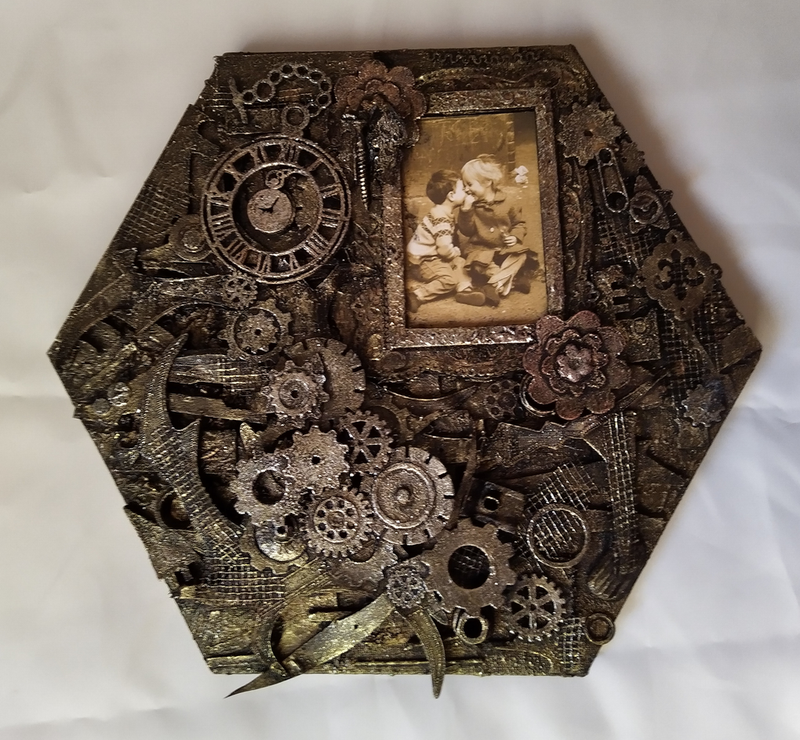


A Moment in Time-1
A Mixed Media Exploration
In the shadowy quiet of my studio, where light plays an intimate game with darkness, a single canvas commands the room’s attention. It stands resolute, a presence both still and alive, wrapped in textures, hues, and layers that pulse with emotion. Titled A Moment in Time‑1, this mixed media piece is more than a simple exploration of materials — it is a dialogue between the past and the present, between memory and emotion. I invite viewers to immerse themselves in an experience that transcends the visual, urging them to confront the transient nature of time and the stories it leaves behind.
From a distance, I see the canvas holding its own quiet mystery, but as I move closer, I’m drawn into a labyrinth of symbols, textures, and found objects that blur the line between reality and recollection. For me, A Moment in Time‑1 is more than a piece of art — it is a portal, a moment suspended between what was and what is, where the mundane becomes sacred and the chaos of the present folds into the nostalgia of the past.
The Power of the Clock, Time Captured
At the centre of the piece, I placed a small but significant clock, resting silently on the canvas. Its face, once crisp and clean, now appears worn and faded — a quiet reflection of time itself. The hands are fixed at 9:05, frozen forever in that fleeting moment, neither advancing nor retreating. That stillness has always fascinated me. It suggests the paradox of time: relentless in its movement, yet always captured in specific moments. For me, the clock doesn’t mark the passing of hours; it encapsulates a fragment of time, a single instance suspended within an infinite continuum.
There is a quiet defiance in that frozen moment. In A Moment in Time‑1, the clock becomes a symbol of memory’s suspended nature — those rare instances that become permanently etched into our consciousness, resistant to the erosion of time.
The frozen hands serve as an anchor, offering a point of reference within the otherwise tumultuous world of the canvas. That fixed moment echoes something deeply human: the times when everything stands still. A child’s laughter, a fleeting glance between lovers, the last moments with someone before they leave — time pauses in those instances. In this piece, the clock honours the profound significance of such moments, as if time itself acknowledges their importance.
The Photograph, A Glimpse into the Past
Beside the clock, I placed a weathered photograph — framed yet fragile — its sepia tones whispering stories of long‑gone eras. Even as it fades, it speaks volumes. For me, it embodies nostalgia: a fragment of the past that refuses to disappear despite the soft erosion of its clarity.
When I look closer, a quiet moment unfolds. A little boy leans forward, tentative yet bold, as if to steal a kiss from the girl beside him. Her expression hovers between surprise and knowing, and I can almost hear the soft giggle that escapes — a spontaneous burst of childhood delight. The scene is simple, but it pulses with innocence and the timelessness of affection. It’s a gesture suspended in time, echoing the very theme of the canvas: that even the smallest moments can carry the weight of memory.
For me, the photograph is not merely an image of people long gone; it symbolises the way we hold on to certain memories. It becomes part of the viewer’s own narrative as much as it is part of mine. It may evoke family gatherings, distant summers, or forgotten faces that once held great importance. It invites each person to search their own history for a similar moment — to consider what they have captured, and what they have allowed to fade.
Placed beside the clock, the fading photograph amplifies the central theme of A Moment in Time‑1: the interplay between memory and time. Memories, like photographs, deteriorate. Yet their impermanence is precisely what makes them precious.
The Layers Tangible Textures of Memory
Beneath the photograph, the canvas reveals layers upon layers of textures I built slowly, each piece becoming an integral part of the whole. Torn pieces of paper, frayed edges of jointing tape, scattered plastic cogs, and other found objects cover the surface. These materials may seem random or chaotic, but for me they represent the detritus of our lives — the moments of disarray we often try to ignore. In A Moment in Time‑1, this chaos becomes meaningful. The rips and tears in the paper are not signs of destruction, but of history. They speak to the inevitable decay of all things, and yet, within that decay, I find beauty.
Each fragment on the canvas carries its own story, a piece of a larger narrative I’m piecing together. The ripped paper might echo the pages of a forgotten diary or the tearing of bonds that once held strong. The plastic cogs — mechanical, man‑made — sit among the organic elements, evoking the passage of time in an industrial world. Every discarded object I place here is imbued with significance, a reminder of the experiences and objects we overlook in the rush of everyday life.
The juxtaposition of natural and artificial components in A Moment in Time‑1 invites me to question how time shapes our lives. What do I discard? What do I hold on to? What do I lose in the process of moving forward?
Organic Elements, The Unstoppable Passage of Nature
Interwoven within the detritus, organic components emerge. A tarnished screw sits beside a dried leaf — a pairing that has always felt symbolic to me. The screw, corroded by time, still suggests a history, a purpose, perhaps even a yearning to be revisited. The leaf, once alive and vibrant, now rests as a delicate fragment of the natural world. Together, they form a quiet juxtaposition of decay and rebirth, of moments slipping away and yet continuing on in a different form.
In A Moment in Time‑1, these organic elements become a meditation on the unstoppable passage of nature, which continues its course even when human‑made moments are frozen in time. The screw and leaf speak to a broader truth: while memories and human experiences are fragile and fleeting, the natural world endures. They remind me that, in the grand scheme of things, we are temporary passengers on a much larger journey. Even in their fragmented, broken state, these elements evoke resilience — the quiet persistence of nature, the ongoing cycle of life and death, growth and decay.
Light and Shadow, The Dance of Memory
One of the most compelling aspects of A Moment in Time‑1 for me is the way light interacts with the canvas. Light shapes the entire experience. As I step closer, shifting shadows of past moments dance across the surface, creating an ephemeral connection between the artwork and whoever stands before it. These fleeting shadows transform the piece from a static object into something living. As the light moves, it highlights and obscures different parts of the artwork, revealing new relationships between the clock, the photograph, the objects, and the textures.
This delicate interplay of light and shadow mirrors the way memory works. Just as light reveals certain details while concealing others, so too does our recollection of the past. Some memories remain sharp and clear; others become faint, elusive, shifting with time. This dynamic quality forces me — and anyone who stands before the canvas — to confront the fluidity of memory. What has been brought into focus by the light of the present? What has been obscured by the shadows of time?
An Invitation to Reflect
A Moment in Time‑1 has always felt like more than a visual experience to me; it is an invitation — a quiet urging — to reflect on the fleeting nature of time and the memories that shape who we become. Through its mixed media composition, I’m asking viewers to step into their own personal narratives, to consider which moments have defined them, and which ones they’ve allowed to slip away unnoticed. I often find myself wondering the same things as I work: What is it that truly defines us? Is it the moments we cling to, or the ones we release? This piece invites that contemplation, opening a dialogue about what it means to live within time, to move through life, and to reflect on the fragments that make up our existence.
The title, A Moment in Time‑1, speaks directly to that singularity. It isn’t just one point in a larger continuum; it is a moment that stands apart — distinct, self‑contained, and resonant. I want the viewer to step into that moment and feel its stillness. In the space between the clock’s frozen hands, the fading photograph, and the chaotic textures of the canvas, I sense both continuity and disruption. There is an invitation to surrender to the flow of time, and at the same moment, a recognition of the permanence of what we choose to hold.
The Living Testament
When I step back from the canvas, the stillness of the clock’s frozen hands becomes a poignant reminder. The vibrancy of the chaotic layers surrounding it speaks to the complexity of life, while the clock’s silence reminds me that time — though always moving — can also stand still. It prompts me to reflect on the fleeting nature of life, to ask myself which moments I will cherish next, and how I will navigate my own labyrinth of time.
In the end, A Moment in Time‑1 is not simply an artwork for me; it is a living testament to the complexity of human experience. Through its mixed media elements, it asks us to recognise the impermanence of time while urging us to hold on to the moments that truly matter. Every moment, no matter how brief, leaves an indelible mark on the fabric of our lives. And as I look at the canvas, I’m reminded that in the blink of an eye, another moment will pass, and another memory will be made. The question that lingers is simple yet profound: What will that moment be — and how will we choose to carry it?
Commission a Custom Art Piece
You can commission a bespoke piece of artwork in your choice of colour (subject to availability), adding a personal touch that reflects your unique story and experiences. Each piece is thoughtfully crafted, ensuring that no two are ever the same, just like the moments they capture. This process fosters a meaningful connection between artist and patron, celebrating the individuality of each person’s journey through time.
Commissions Form
The more detail you provide, the better we can tailor the piece to your vision. Commissions typically take between 2 to 6 weeks to complete.
Thank you for taking the time to explore the commissions process.
Please note, colours may vary from monitor to monitor.
Check out my other works here at https://soloist.ai/lynstef



Reviews
There are no reviews yet.