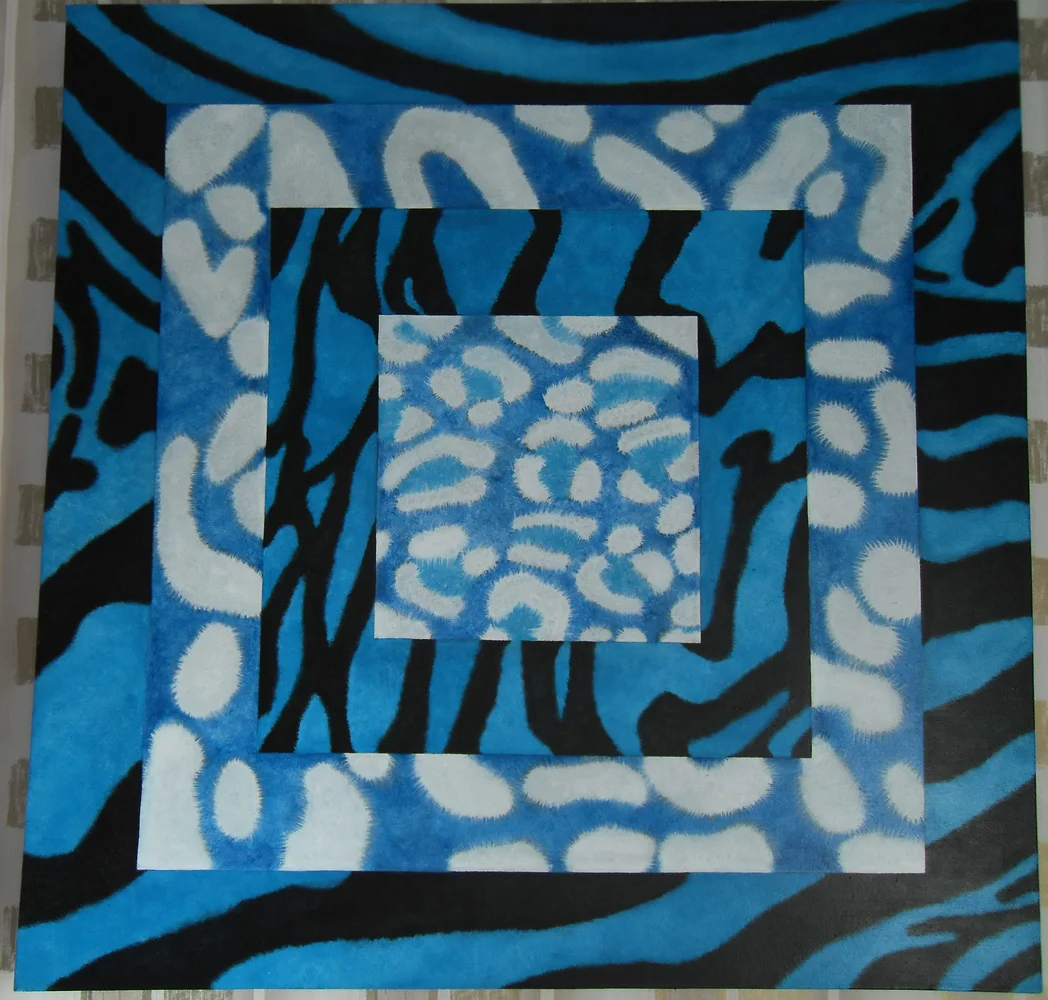
Blue Skins
A Journey Through Layers of colour, Pattern and Perception
Blue Skins is one of those paintings where everything I love — pattern, symbolism, spirals, and layered perception — comes together in a single, shifting surface. Painted in acrylic on canvas, this piece invites the viewer to look beyond the obvious, to question what is seen and what is hidden, and to explore the deeper meanings that lie beneath the patterns of the natural world.
At first glance, the painting appears to be a tangle of animal prints — zebra, leopard, tiger, and jaguar — woven together in a complex, almost hypnotic arrangement. But the work is not simply a study of animal skins. It is a symbolic journey into nature, identity, and perception, where each layer reveals something different depending on how long you look.
The title, Blue Skins, hints at mystery, but the real intrigue lies in the way the patterns shift and move. The longer you engage with the painting, the more the layers seem to rearrange themselves, creating an optical illusion that mirrors the fluid nature of perception itself.
The Symbolism of the Four Animals
Each animal carries its own meaning, and each layer in the painting reflects a different aspect of the natural and psychological world.
1. The Zebra — Balance and Duality
The zebra’s black‑and‑white stripes speak to contrast: light and dark, order and chaos, harmony and tension. In this piece, the zebra layer represents the coexistence of opposites — the idea that dualities are not contradictions, but partners in balance. The hints of blue woven through the stripes suggest that even stark contrasts contain nuance.
2. The Leopard — Stealth and Camouflage
The leopard’s rosettes symbolise adaptability, subtlety, and the truths that hide in plain sight. In 4 Blue Skins, this layer feels fluid and elusive, echoing the way we often move through life — blending in, shifting shape, and revealing only what we choose to reveal.
3. The Tiger — Strength and Courage
The tiger’s bold stripes evoke raw power and determination. In the painting, this layer reflects the primal forces that shape us — courage, instinct, and the unpredictable nature of strength. The swirling shapes within the stripes hint at the way courage can shift depending on circumstance.
4. The Jaguar — Mystery and Transformation
The jaguar’s deep, hypnotic markings represent the unknown, the mystical, and the transformative. This layer invites the viewer to peer into the unseen forces of nature — the mysteries that lie beneath the surface of our lives and our perceptions.
Together, these four animals form a symbolic tapestry. Their interwoven patterns reflect the layered nature of existence — the contradictions, strengths, shadows, and transformations that shape who we are.
The Optical Illusion — Layers in Motion
One of the most intriguing aspects of Blue Skins is the way the layers appear to move. The patterns shift depending on where your eye lands, creating a sense of motion within a static surface. This is intentional — a visual metaphor for the fluidity of perception.
Our understanding of reality is never fixed. It changes with time, emotion, memory, and experience. Just as the layers in the painting seem to rearrange themselves, so too does our sense of the world. The spirals woven throughout the piece reinforce this idea. Spirals have long been a symbol of growth, transformation, and the journey inward. Here, they draw the viewer deeper into the painting, inviting contemplation and introspection.
Technique — Colour, Layering, and Depth
Acrylics allowed me to build this piece in layers — each one distinct, yet connected. The palette of blues, blacks, and whites unifies the four animal skins while creating depth and atmosphere. The colours evoke mystery, movement, and the cool stillness of shadowed spaces.
The layering is essential. Each pattern sits atop another, yet none fully dominates. This creates a multidimensional surface that feels alive — shifting, breathing, and revealing new details with every glance.
Conclusion — The Power of Blue Skins
Blue Skins is a painting that asks the viewer to look deeply, to move past the surface and into the layers beneath. It explores the complexity of nature, the fluidity of perception, and the ever‑changing nature of reality.
The shifting patterns, the hypnotic spirals, and the interplay of four powerful animal symbols create a work that is both visually striking and conceptually rich. Each time you return to it, something new emerges. The layers shift. The patterns change. And you are reminded that nothing in life is ever truly fixed — everything is in motion, evolving, and waiting to be seen from a new angle.
Through Blue Skins, I hope to offer a reminder of the layered world we inhabit — a world full of contradictions, mysteries, and hidden depths — and to invite viewers to embrace the possibility that there is always more to life than meets the eye.
Commission a Custom Art Piece
You can commission a bespoke piece of artwork in your choice of colour (subject to availability), adding a personal touch that reflects your unique story and experiences. Each piece is thoughtfully crafted, ensuring that no two are ever the same, just like the moments they capture.
This process fosters a meaningful connection between artist and patron, celebrating the individuality of each person’s journey through time.
Commissions Form
The more detail you provide, the better we can tailor the piece to your vision. Commissions typically take between 2 to 6 weeks to complete.
Thank you for taking the time to explore the commissions process.
Please note, colours may vary from monitor to monitor.
Check out my other works here at https://soloist.ai/lynstef

Reviews
There are no reviews yet.